AI Patent Drafting and Search Are Not Fire-and-Forget
Fire-and-forget AI can hide how patent claims or infringement leads were generated. Alex Levin explains why the process, evidence, and human review still matter.
Key Takeaways
- Fire-and-forget skips two checks. The process is not examined, and the result is accepted without review.
- AI-drafted claims need traceability. Review terminology, functional claim language, disclosure support, and inventorship.
- Infringement search results are leads. Review the source evidence, each claim limitation, claim interpretation, and search scope behind a ranking.
- Accountability remains human. Practitioners must verify AI-assisted filings and assess infringement claims before taking legal action.
AI Patent Drafting and Search Are Not Fire-and-Forget
In short: Fire-and-forget AI combines two shortcuts: never looking at how the system reached its output, and accepting that output as is. In patent drafting and infringement search, neither is responsible. U.S. rules leave review with the person who signs or files, and litigation tests every claim term and every lead. The speed is real; the forgetting is not.
The most expensive promise in AI right now is not speed. It is the promise that you can fire and forget.
The phrase comes from missile guidance: once launched, the weapon steers itself, and the operator can turn to something else. Applied to knowledge work, it means handing the task to a system, never looking at the process, and accepting the result as is.
That definition holds two shortcuts that fail in different ways. Skipping the process means not knowing what the system relied on, what it assumed, or where its words came from. Accepting the result as is means treating output that looks finished as finished. In patent work, either one can cause damage that surfaces years later.
I co-founded a company that builds AI for patent work, so I am not a neutral observer, and I have no quarrel with the “fire” half. The “forget” half is where the cost sits. Two stories written long before large language models show why.
What did Chaplin’s feeding machine ask its buyer to forget?
Both the process and the result. In Modern Times, which premiered in New York on February 5, 1936, salesmen wheel the Billows Feeding Machine into a factory president’s office. The pitch plays from a phonograph record, promising the device will “eliminate the lunch hour,” raise output, and cut overhead. The promises were recorded before any demonstration took place. The promise itself is fire-and-forget: the machine feeds the worker while he keeps working, untended.
Then they demonstrate it on the Tramp. Left to run, the machine speeds up, misfires, and leaves him wearing the soup and the dessert. The president passes.
To his credit, he refused both shortcuts. He did not accept the recorded result, and he insisted on watching the process on his own worker before he bought. With software, those are often the first two steps skipped.
What did Phileas Fogg check that the newspaper did not?
The route, not just the total. Around the World in Eighty Days, first serialized in 1872, opens with a London newspaper’s estimate (the Morning Chronicle in Verne’s French; some English translations name the Daily Telegraph). It shows the world can now be circled in eighty days, thanks to a newly opened section of the Great Indian Peninsula Railway. Eighty days is a result. When one of his whist partners objects that storms and accidents are not counted, Fogg replies: “All included.”
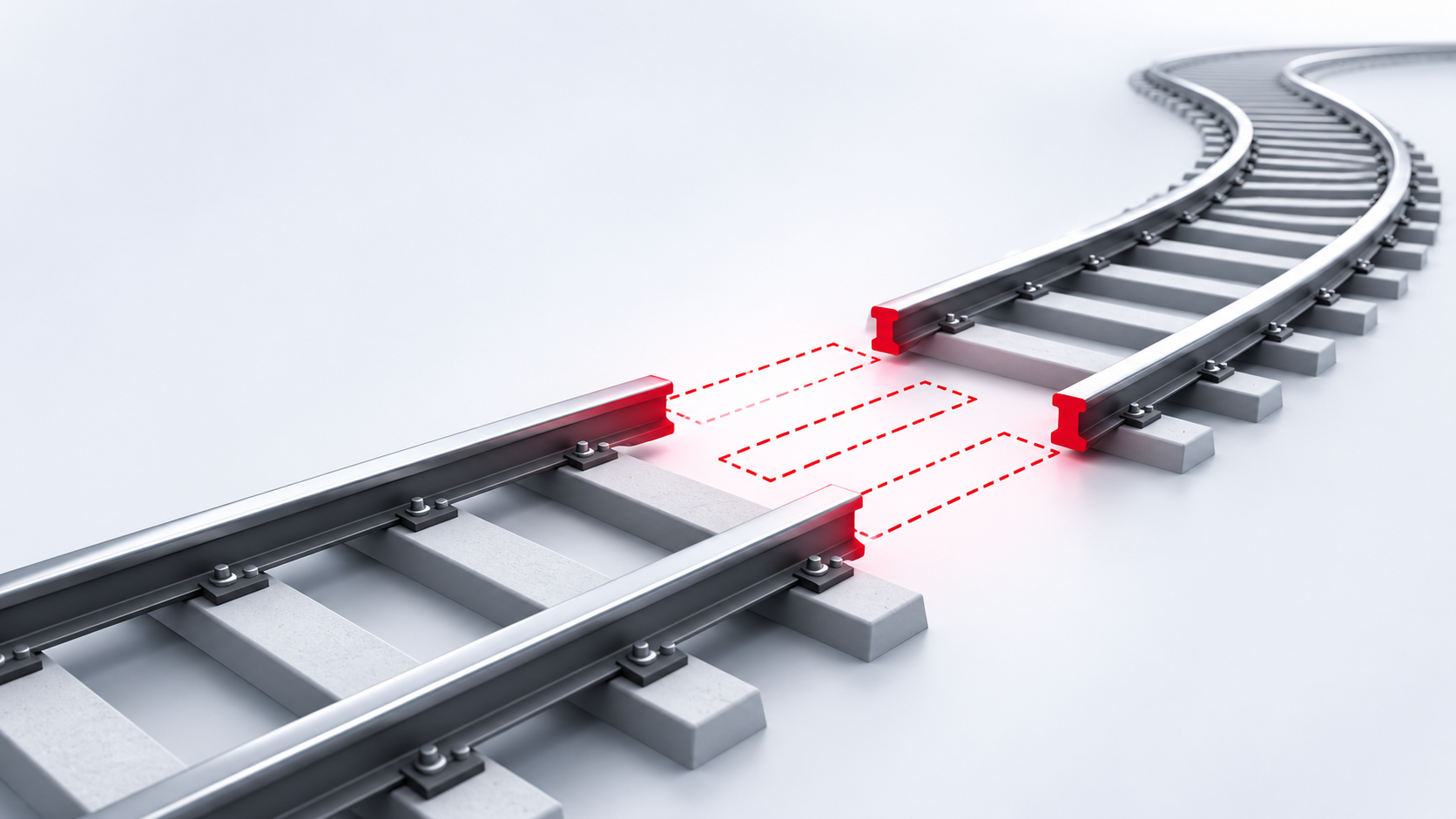
It sounds like a man accepting the result as is. His conduct says otherwise. In India, the train stops at Kholby: about fifty miles of track to Allahabad have not been laid. A passenger protests that the papers announced the line open throughout. The conductor answers: “The papers were mistaken.” Fogg is not surprised. He says the delay was foreseen, buys an elephant for £2,000, and keeps moving.
The newspaper published a total. Fogg worked from the route, connection by connection, and had budgeted for the gaps. That is the parallel for AI: most of today’s track is real, and fire-and-forget is believing the announcement that the line is complete.
What does looking at the process mean in AI patent drafting and search?
It means knowing how the output was produced, not just what it says: in drafting, where each part of the text came from; in search, the evidence and reasoning behind each lead. In both, the defects that matter most are often visible only in the process.
In drafting
Terms the model varied. Good prose avoids repeating a word, so a model may call the same part a housing, a casing, and an enclosure within three paragraphs. In a patent, three words invite the argument that there are three things. In Nautilus v. Biosig (2014), the Supreme Court held that a claim is indefinite if, read in light of the specification and prosecution history, it fails to inform skilled artisans about the scope of the invention with reasonable certainty. The final text does not show whether the variation was deliberate.
Phrases the model supplied. Models default to tidy wording such as “a processing module configured to.” Since Williamson v. Citrix Online (Fed. Cir. 2015, en banc in part), a term like “module” can be treated as a means-plus-function limitation under 35 U.S.C. § 112(f) even without the word “means,” and held indefinite if the specification discloses no corresponding structure. Someone has to know which functional phrases came with structure behind them.
Claims the inventors did not conceive. The USPTO’s revised inventorship guidance, published November 28, 2025, confirms that only natural persons can be inventors and that conception remains the touchstone. Only someone who knows which claim language traces to an inventor can answer that.
In infringement search
This is the kind of tool my company builds. An AI infringement search can return candidate products in minutes, ranked by how closely they correspond to a patent’s claims. The ranking is the result. The process is everything behind it.
Where the evidence came from. Each match rests on a document: a product page, a manual, a datasheet, a teardown. Its date and the product version it describes matter; marketing copy for a discontinued model says little about the current one. The score does not show which kind of evidence it rests on.
How each limitation was matched. Behind the score sits a mapping of which feature was said to meet which limitation, and which were met weakly or not at all. A high score can hide one limitation with no support. Only the mapping shows it.
How the claim was read. To match anything, a tool has to interpret the claim terms. That reading may not be the one a court adopts in light of the specification and prosecution history. If the search read “fastener” broadly, every lead depends on that choice.
What the search did not cover. Every search has a scope of sources, products, markets, and dates. A short list can mean few products correspond, or that the search did not look where they are.
Why can’t an AI draft be accepted as is?
Because the duty to review stays with a person, and a patent’s real test comes long after drafting. The USPTO does not forbid AI drafting. Its April 11, 2024 guidance on AI-based tools states that there is no prohibition against using computer tools to draft documents for submission. The same guidance rules out accepting the output as is: “Simply relying on the accuracy of an AI tool is not a reasonable inquiry.” The party presenting a paper must have reviewed and verified it, and the guidance adds that the duty of disclosure cannot be transferred to another person or to a computer system such as an AI tool.
On February 2, 2026, a federal court in Kansas found that all five attorneys who signed briefs in Lexos Media IP v. Overstock.com, a patent case, violated Rule 11. The briefs cited a nonexistent case and quotations missing from the opinions cited. One attorney had used ChatGPT without verifying its output; the other signers were held responsible anyway.
Accepting the result also hides what only a review would catch. Ask a model for broad claims and it will write them. Whether the specification enables that full scope is a separate question; in Amgen v. Sanofi (2023), a unanimous Supreme Court affirmed that the more one claims, the more one must enable. Such defects do not necessarily stop an application from being allowed; examination is not an adversarial read. An issued claim is presumed valid under 35 U.S.C. § 282, but that presumption is a starting position, not armor. When the patent is asserted, the other side reads every term, every functional phrase, and every broad limitation looking for exactly these gaps.
At that point the decision reduces to budget, not opinion: hours saved at drafting against a weak claim’s cost over the asset’s life, from maintenance fees on a patent nobody will assert to licensing talks that end at claim 1.
Can an infringement search result be acted on as is?
No. A ranked list of potential infringers looks like an answer, but it is a queue of leads. In Warner-Jenkinson v. Hilton Davis (1997), the Supreme Court framed the essential inquiry as whether the accused product contains elements identical or equivalent to each claimed element. A score can show that much of a claim appears to correspond. It cannot confirm that every limitation is present, and if a single limitation is absent both literally and by equivalent, that claim is not infringed. Nor can a ranking settle whether the activity falls within the territory and term the patent covers.
Courts expect that review before anyone acts. The Federal Circuit has read Rule 11 to require, at a minimum, that an attorney interpret the asserted claims and compare the accused device with them before filing an infringement claim (Q-Pharma v. Andrew Jergens, 2004; see also Judin v. United States, 1997). A search report can make that comparison faster and better organized. It cannot perform it on counsel’s behalf.
What does AI-assisted patent work look like when nobody forgets?
Fire, then look. The argument is not for slower patent work; it is for knowing which fifty miles are still unbuilt.
Keep the process visible
- Track provenance in drafts. Know which language came from the inventor and which from the model.
- Enforce one term per concept. Use AI to hunt for synonyms in the draft, not to write them.
- Trace every claim limitation to the specification. If a functional term has no disclosed structure, fix it before filing, not during claim construction.
- Open the evidence behind every search lead. Check the source, the mapping, the claim reading, and the scope before trusting the score.
Never accept the result as is
- Let a practitioner own every word. A signature certifies a reasonable inquiry, and relying on a tool’s accuracy is not one.
- Record what the inventors conceived. Keep each claim connected to a named person’s contribution.
- Treat search results as a queue, not a verdict. Review each lead limitation by limitation before anyone acts on it.
- Test the claims against the market while they can still change. Prosecution is the cheapest time to learn whether a claim corresponds to anything real. That is the work PioneerIP’s Claim Optimizer is built for: evaluating pending claims against products on the market as if granted, as an input for the practitioner deciding on amendments. It is a checkpoint, not a substitute for one.
The takeaway
Chaplin’s factory president refused the recorded pitch and watched the machine work. Fogg ignored the newspaper’s total and checked the route. Neither rejected the technology; both refused to stop paying attention.
Automate the firing. Never automate the forgetting. Keep the process visible, and treat no draft or ranked list as finished until a qualified person has checked it.
Add a checkpoint before your claims are fixed
Claim Optimizer evaluates pending or draft claims of a published application against market products, as an analytical input for the practitioner’s amendment decisions. Request a demo
About the author
Alex Levin is Co-Founder of PioneerIP. He holds an MBA from the Schulich School of Business and an LLM in intellectual property from Osgoode Hall Law School.
Disclaimer: PioneerIP is a software platform, not a law firm. It does not provide legal advice, legal opinions, or legal services. Reports and analytics generated by the platform are analytical inputs for qualified counsel and are provided for informational purposes only.
This article is general commentary on U.S. law and practice as of November 9, 2026. It is not legal advice and does not create an attorney-client relationship.