

Validity Search
Assess the enforcement argument's strength before you pursue licensing
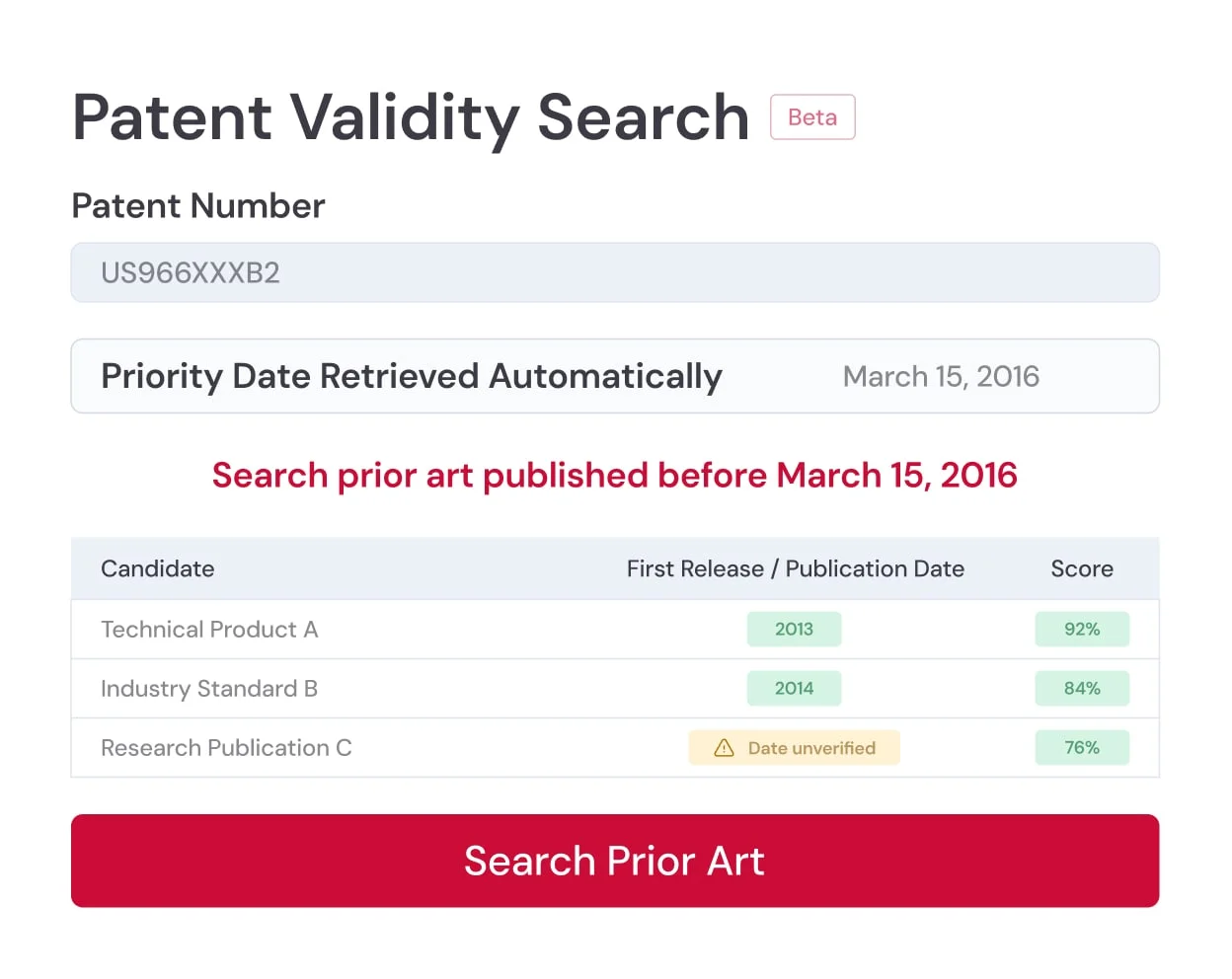
Identify patent-invalidating prior art ahead of commencing licensing or litigation activities. Seek invalidating art for asserted patents. PioneerIP Validity Search helps patent professionals search across non-patent literature to understand whether a patent is valid — providing an additional, previously not covered layer of product data to the validity searches.
Why Validity Search Matters
Before you enforce a patent, know how strong it really is
A patent may look commercially valuable because it maps to real products or potential licensees. But before pursuing a licensing campaign or enforcement strategy, a patent professional needs to understand whether the patent can withstand validity challenges.
Invalidating prior art can weaken negotiation leverage, increase litigation risk, or change whether a patent is worth enforcing at all.
The problem Validity Search solves
Patent strength oftentimes needs to be assessed.

Will the patent withstand invalidating inquiry?
Is the FTO problem presented by a patent a real problem?
Validity search addresses these questions.
By looking into products, standards, ads and videos, PioneerIP uses a layer of data previously untapped by traditional search platforms, thus creating deeper validity understanding - and stronger invalidating arguments.

What Validity Search Does
Identifies invalidating prior art
Surface non-patent references that may affect claim validity or enforcement strength.
Assesses enforcement readiness
Help determine whether a patent is strong enough to support licensing outreach, enforcement planning, or litigation preparation.
Reduces litigation risk
Identify validity weaknesses earlier, before investing in demand letters, licensing negotiations, or legal proceedings.
Searches beyond patent databases
Analyze standards, technical manuals, product documentation, archived web materials, and other non-patent literature.
Maps evidence to claim limitations
Connect prior art disclosures to specific claim elements so reviewers can understand why a reference may matter.
Supports go / no-go decisions
Give patent owners, law firms, and IP teams clearer evidence before deciding whether to enforce, license, continue, sell, or abandon a patent.
Built for enforcement and litigation readiness
Licensing strategy
Check for invalidating prior art before approaching potential licensees.
Enforcement planning
Assess whether the patent is strong enough to support enforcement before investing in legal action.
Litigation risk review
Identify prior art that could be used against the patent in invalidity defenses.Prioritized potential licensees or infringers to inform drafting choices
Portfolio monetization
Prioritize patents that are not only commercially relevant but also stronger from a validity perspective.
Clients’ success stories
See how IP leaders like you turned patent data into clear business decisions. Real success stories from clients who made their patents work harder

Faster infringement searches and portfolio analysis

Searches and portfolio analysis with AI handling

PioneerIP provides a practical and efficient way to analyze patents for licensing, enforcement, and portfolio management opportunities. The platform substantially reduces the time required to identify potentially relevant products and companies, enabling our IP Team Members to focus their efforts on the highest-value opportunities.

The biggest challenge in patent monetization has always been identifying high-value enforcement targets with confidence... PioneerIP's AI-powered platform has dramatically reduced this bottleneck, turning what used to be weeks of uncertain manual analysis into data-driven intelligence delivered in minutes. The automated claim charts and evidence collection have accelerated my licensing negotiations and enforcement decisions, directly impacting my clients' ability to monetize their IP portfolios.

"Thanks to PioneerIP I have a very, very happy client. My client was considering not paying a maintenance fee for a US patent in a relatively obscure technology area. We gave PioneerIP a try, and they found several potential licensees. Needless to say, my client now thinks I’m (even more) wonderful."

"PioneerIP, provides us with a practical way to monitor our portfolio for potential infringement. It offered helpful insights for decision making around patent maintenance and CON filings."

"As a plastic surgeon and inventor, protecting my ideas is personal. PioneerIP gave me clarity I never had before - within minutes, I could see who might be using my patented technique. It’s simple, fast, and finally makes infringement search accessible to individual innovators like me."

"From day one, their team has been incredibly responsive to our feature requests, consistently taking our feedback, refining their design, and implementing enhancements at an impressive speed.The platform has significantly improved our efficiency, allowing us to analyze infringement cases more effectively."
"PioneerIP gives us a completely new way to approach patent enforcement. Instead of sifting through endless data, we get a prioritized list of potential infringers in minutes. It’s not just about speed - it’s about confidence in knowing where to focus our efforts."

"Having worked inside a global tech company, I’ve seen how hard it is to monitor a large patent portfolio effectively. PioneerIP solves that pain. It spots red flags early and gives you a clear path to act - without spending months and a fortune on manual reviews."
"At last, a market evidence based tool to make decisions on IP portfolio management. Highly(!) recommended."


Know the validity risk before you enforce
Validity Search helps patent teams identify patent-invalidating prior art, assess enforcement strength, and reduce litigation risk before pursuing licensing or enforcement.